

How to Get the Best Price for Your Trade-In
Most people leave money on the table when they trade in a car. They didn't get cheated and they're not bad negotiators. They just didn't know the rules of the game going in.
The good news? A little preparation goes a long way. Here's exactly what moves the needle on trade-in value and how to walk into Coulter Nissan (or anywhere) knowing your car is worth every dollar you're asking for.
Look up your car's value

This is where things go wrong for many people. Before you step foot on any lot, check Coulter Nissan's online estimator tool powered by KBB.com, the industry standard. Plug some details about your vehicle.
- First Screen
- Year
- Make
- Model
- Style
- Second Screen
- Transmission
- Engine
- Drivetrain
- Third Screen
- Condition (Be very honest here. It's better to err on the side of caution.)
- Mileage (You'll select a range.)
- Fourth Screen
- Your Contact Info
- Your interest (A new vehicle? A used vehicle? Selling outright?)
It sounds like you need a lot of info, but it's honestly pretty easy. The form filters based on your make, model, etc. Once you click the "Get Your Range" button on that fourth screen, the tool gives you an estimated range of what you can expect. Below is the range I got for my car. It took about three minutes.
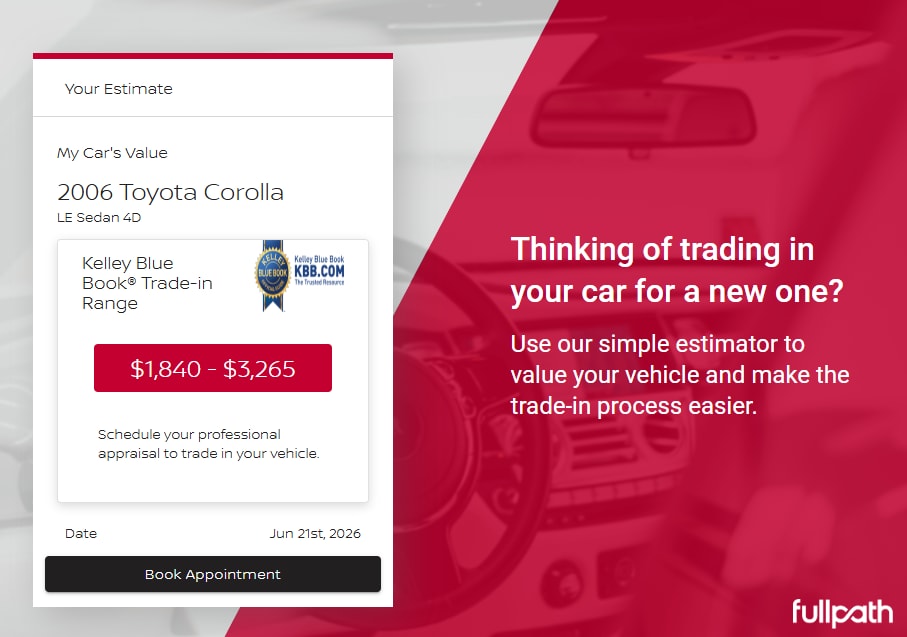
Write it down! That range is your anchor.
Prepared, informed buyers consistently get the best trade-in deals. Dealers know immediately whether you've done your homework. Walking in with a number and knowing where it came from changes the entire dynamic of the conversation.
Clean it like you're trying to sell it yourself
First impressions affect appraisals. A car that looks cared for is treated like one that was. You don't need a professional detail. But you do need a real wash, a vacuumed interior, and no evidence of chaos in the back seat. Wipe down the dash. Clear out the trunk. Make it look like a car you would want to buy.
Fix the cheap stuff. Ignore the expensive stuff.
Burned-out bulb? Fix it. Cracked wiper? Swap it. Anything visible and under $50 is worth addressing. A $1,500 repair is not. Dealers buy at wholesale costs. You will not recoup retail repair prices in a trade-in offer. Save your money.
Check for warning lights, too. A car with a clean bill of health is more desirable, and a dashboard full of caution lights is a red flag that drops offers fast. Address what you can before you come in.

Bring your paperwork and the keys (all of them!)
Title, current registration, and any service records you have, including oil changes, tire rotations, and major repairs. Documented maintenance history is proof that the car was looked after. That proof moves the needle. (If you've had service done at Coulter Nissan, we already have your records on file. That's one less thing to worry about.)
If you don't have a title, you can order a replacement or duplicate for $4 on AZMVDNow.com. It will arrive in the mail. You can print your current registration there, too.
If there's an outstanding loan, call your lender before you come in and ask for the 10-day payoff figure. Know exactly what you owe.
You'll need to hand over your keys and fobs. Don't forget the spares. Missing keys cost $200–$400 to replace. Dealers can deduct that from your offer.
Don't let everything get bundled together at once
This is where deals get murky. Get a firm trade-in number before monthly payments or purchase price enter the conversation. Once everything gets rolled into one big negotiation, it becomes nearly impossible to track where the value is going. There are too many moving parts, and too many opportunities for the numbers to shift quietly in the wrong direction.
Separate the conversations. It's your right to do that.
Negotiate your trade-in value first. Agree on a number. Then talk about what you're buying. Keeping them separate gives you clarity and leverage at every step.
Timing is everything
Timing affects trade-in value more than most people realize.
Q1 and Q2, the first half of the year, tend to be the strongest periods for trade-in values as used car demand trends higher. The type of vehicle matters too. An AWD SUV trades well in cooler months when demand is up. A convertible does better in spring and summer.
End of the month is also worth noting. Trading in at the end of the month, quarter, or year, when dealerships are motivated to meet sales quotas, can give you additional leverage in negotiations.
Get more than one offer
You're not obligated to trade-in where you buy. Getting a second appraisal, whether from another dealer or a service like CarMax, gives you a real market comparison and negotiating ammunition.
If Coulter Nissan's offer is stronger, great. If someone else is higher, bring that number in. A competing offer is one of the most effective tools a trade-in seller has.
Come see what your trade is worth
Coulter Nissan offers no-obligation trade-in appraisals in Surprise. Come in with your research, your paperwork, and your vehicle, and we'll give you a straight answer.
Frequently Asked Questions
How do I find out what my car is worth before trading it in?
Start with Coulter Nissan's easy online appraisal request powered by KBB.com to get a reliable estimate based on your year, make, model, mileage, and condition. Be honest about your condition rating. Overestimating condition is the most common mistake buyers make.
Should I clean my car before a trade-in appraisal?
Yes, and be thorough. Give it a real wash, vacuum the interior, including under the seats, wipe down the dash and all hard surfaces, clean the windows inside and out, and clear everything out of the trunk and back seat. You don't need a professional detail, but you do need to show that you took decent care of your vehicle. Appraisers see dozens of cars a day. A clean, organized vehicle signals responsible ownership, and that perception factors directly into the offer.
Can I trade in a car I still owe money on?
Yes. If your car is worth more than what you owe, the difference is applied as equity toward your next vehicle. If you owe more than it's worth, called negative equity, the balance can often be rolled into your new loan.
Is it better to sell my car privately or trade it in?
Private sales often yield more money on paper, but they come with real tradeoffs like time, hassle, safety considerations when meeting strangers, and no guarantee of a quick sale. A trade-in is faster, simpler, and the value applies directly to your next purchase, often with a sales tax benefit on the difference. For most people, the convenience is worth a modest price difference. If maximizing every dollar is the priority and you have the time and patience for a private sale, it can make sense. But for most people, trading in is the smarter practical move.
Does Coulter Nissan buy cars I'm not trading in?
Yes. You can sell your vehicle to Coulter Nissan without purchasing another one. Get your appraisal started here.
What documents do I need to trade in my car?
Bring your title, current registration, driver's license, and all spare keys and remotes. Missing keys cost $200–$400 to replace, and dealers deduct that from your offer. If you have maintenance records, bring those, too. Documented oil changes, tire rotations, and repairs are proof that the vehicle was looked after, and that proof moves the needle on your appraisal. If you have an outstanding loan, call your lender before you come in and ask for the 10-day payoff figure so you know exactly where you stand on equity.